
Heat load
The building heat load describes the required output at the design condition. It is the starting point for sizing.
The best heat pump is not the one with the highest nominal output. It is the one whose performance, minimum output and efficiency fit the building, the design conditions and the intended supply temperature.
Short answer
A heat pump should be sized from the building's heat load, not from a single kW value. The right system depends on the heat load curve, performance curve, modulation range, supply temperature and efficiency at real operating conditions.
Reviewed by Prometo · Last updated:
The building heat load describes the required output at the design condition. It is the starting point for sizing.
The curve shows how much heat a heat pump can deliver at specific outdoor temperatures and supply temperatures.
The modulation range determines whether the unit can run steadily in milder weather or starts cycling.
It marks where an additional heat source may support the heat pump. The point is project-specific.
Efficiency values are only comparable when the operating point, climate reference and temperature level are clear. A high COP at W35 says little about operation at W55.
| Metric | Meaning | How to compare |
|---|---|---|
| COP | Efficiency at one defined operating point, such as A-7/W35 | Compare only at the same operating point and supply temperature |
| SCOP | Seasonal reference value under standardized conditions | Do not treat it as the actual building consumption |
| JAZ / APF | Annual performance factor for a specific system or planning scenario | Depends on system boundary, supply temperature, usage and hydraulics |
A-7/W35 means outdoor air at minus 7 degrees Celsius and heating water supply at 35 degrees Celsius. If the same compressor is operated at W55, efficiency can be much lower. Every data sheet has to be read against the real supply temperature.
The better heat pump is the one whose output, modulation range and efficiency fit the building, supply temperature and operating point. A higher maximum output can be worse when the minimum output is too high.
Sum room heat loads and check plausibility against building, location and usage.
Radiators, underfloor heating and system temperatures strongly influence real efficiency.
Check output at A-7/W35, A2/W35 and A7/W35, plus minimum output and operating limits.
Assess backup heater share, domestic hot water, utility lockout periods and defrost behavior.
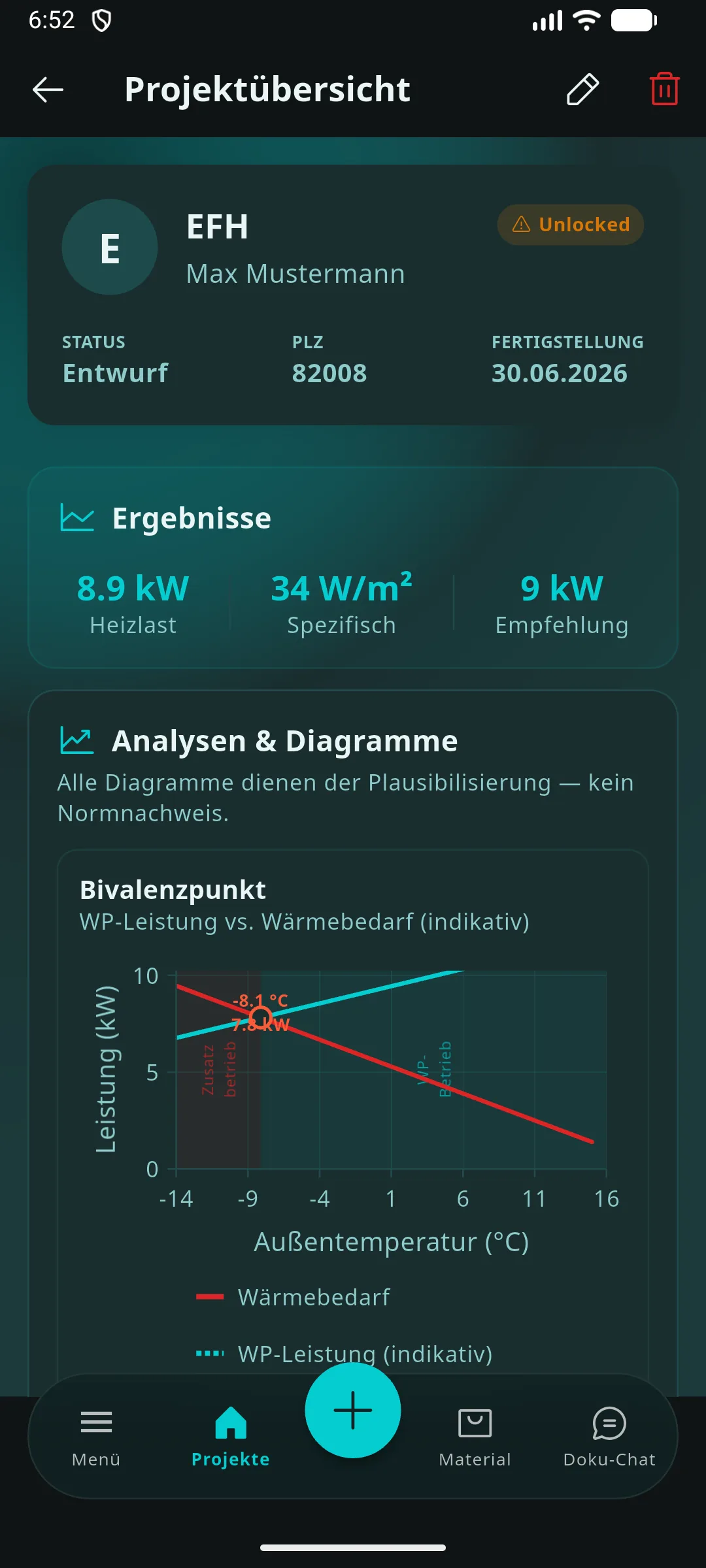
Prometo connects PDF floor plans, room-by-room heat load, specific load, bivalence point, surface heating and hydraulic balancing in one project model. Heat pump sizing starts in the building context, not in isolation.
Final manufacturer selection and incentive checks remain project-specific. Prometo provides the structured technical basis for the workflow.
Start with the building heat load at the design outdoor temperature. Then check the performance curve, modulation range, supply temperature, hot water demand, defrost behavior and bivalence strategy. A single kW figure is not enough.
COP is the efficiency at one defined operating point. SCOP is a seasonal reference value under standardized conditions. JAZ is the annual system efficiency for a specific building or planning scenario.
No. The right system is the one whose output, minimum output, modulation range, efficiency and temperature capability fit the building. Too much minimum output can cause frequent cycling.
A-7/W35 is an operating point: outdoor air at minus 7 degrees Celsius and heating water supply at 35 degrees Celsius. Performance values are only comparable when the operating point is identical.
The bivalence point marks the point where an additional heat source may support the heat pump. It depends on the building heat load, system design and operating strategy.
Schematic charts and example curves on this page are not manufacturer comparisons. Specific projects require manufacturer data sheets, operating points, application limits, local incentive rules and the project-specific heat load. No warranty is given.